
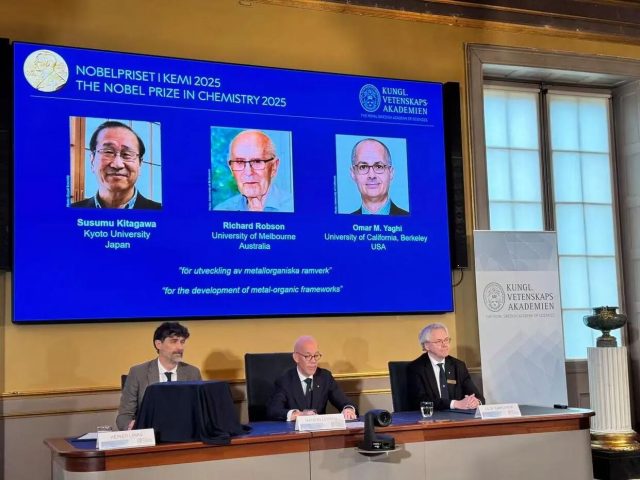

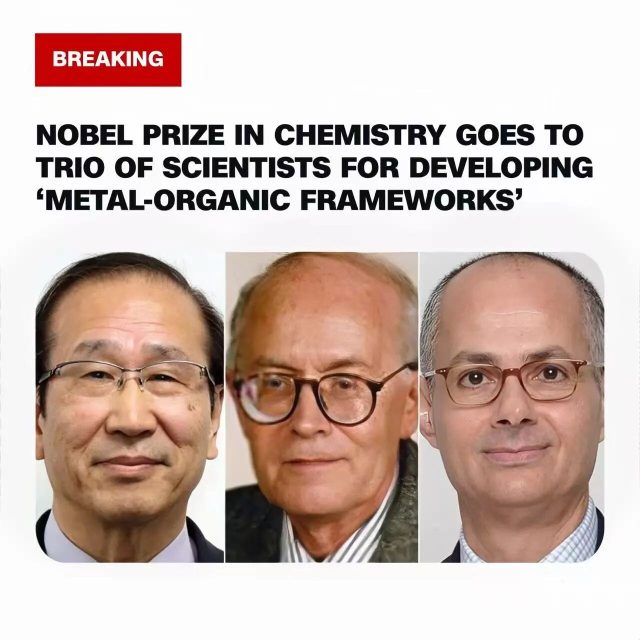
简而言之,金属有机框架(MOF)极具应用价值。下村脩(Susumu Kitagawa)、理查德・罗布森(Richard Robson)与奥马尔・亚吉(Omar Yaghi)因成功合成首批金属有机框架并证实其应用潜力,荣获 2025 年诺贝尔化学奖。得益于这三位获奖者的研究成果,化学家们已能设计出数以万计的不同类型金属有机框架,为一系列全新化学领域的突破创造了条件。
▫️ 北川进(日本):90 年代提出「柔性 MOFs」概念,让材料能像呼吸般随外界刺激变形


▫️ 奥马尔・亚基(美):开发上千种 MOFs 结构,攻克氢气储存、碳捕获等应用难题
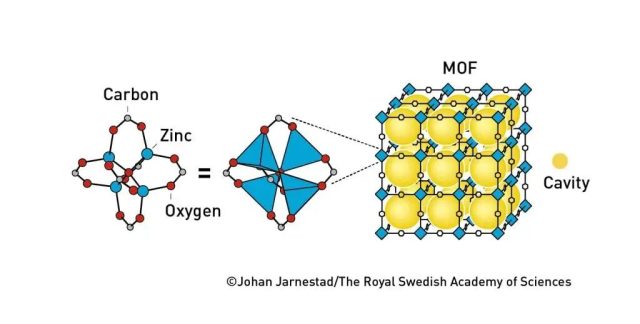
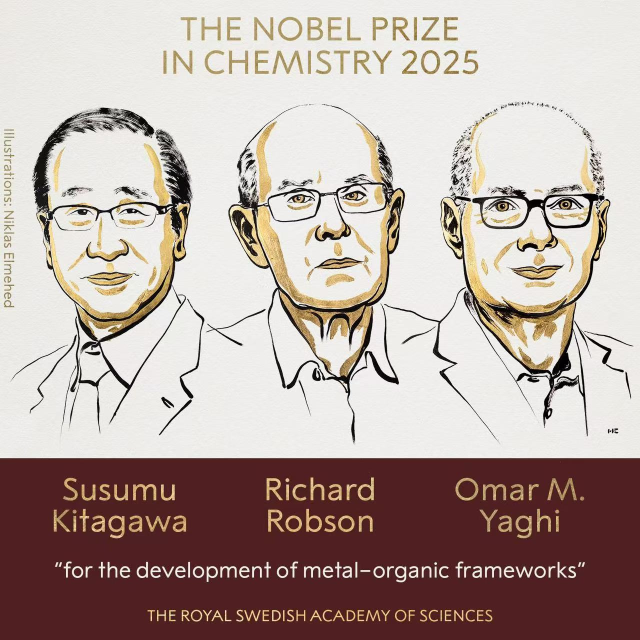
Susumu Kitagawa, Richard Robson and Omar Yaghi are awarded the Nobel Prize in Chemistry 2025. They have developed a new form of molecular architecture. In their constructions, metal ions function as cornerstones that are linked by long organic (carbon-based) molecules. Together, the metal ions and molecules are organised to form crystals that contain large cavities. These porous materials are called metal-organic frameworks (MOF). By varying the building blocks used in the MOFs, chemists can design them to capture and store specific substances. MOFs can also drive chemical reactions or conduct electricity.
“Metal-organic frameworks have enormous potential, bringing previously unforeseen opportunities for custom-made materials with new functions,” says Heiner Linke, Chair of the Nobel Committee for Chemistry.
It all started in 1989, when Richard Robson tested utilising the inherent properties of atoms in a new way. He combined positively charged copper ions with a four-armed molecule; this had a chemical group that was attracted to copper ions at the end of each arm.
When they were combined, they bonded to form a well-ordered, spacious crystal. It was like a diamond filled with innumerable cavities.
Robson immediately recognised the potential of his molecular construction, but it was unstable and collapsed easily. However, Susumu Kitagawa and Omar Yaghi provided this building method with a firm foundation; between 1992 and 2003 they made, separately, a series of revolutionary discoveries. Kitagawa showed that gases can flow in and out of the constructions and predicted that MOFs could be made flexible. Yaghi created a very stable MOF and showed that it can be modified using rational design, giving it new and desirable properties.
Following the laureates’ groundbreaking discoveries, chemists have built tens of thousands of different MOFs. Some of these may contribute to solving some of humankind’s greatest challenges, with applications that include separating PFAS from water, breaking down traces of pharmaceuticals in the environment, capturing carbon dioxide or harvesting water from desert air.

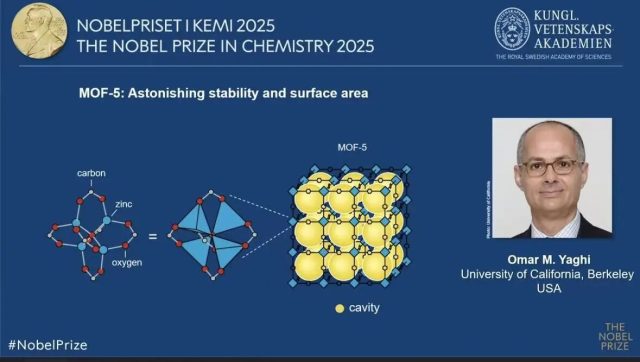
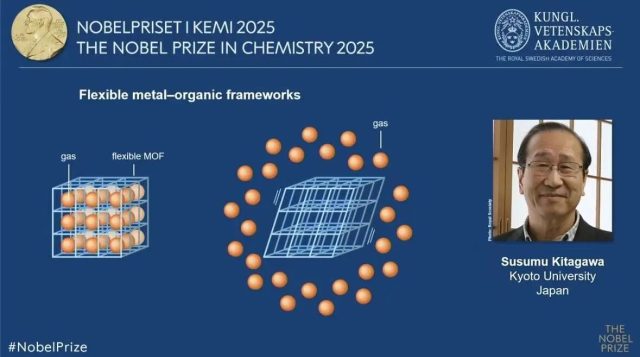
2025 年诺贝尔化学奖得主创造出了一种具有巨大空间的分子结构,气体及其他化学物质可在其中流动。这类被称为 “金属有机框架”(MOF)的结构,能用于从沙漠空气中收集水分、捕获二氧化碳、储存有毒气体,或是催化化学反应。
下村脩(Susumu Kitagawa)、理查德・罗布森(Richard Robson)与奥马尔・亚吉(Omar Yaghi)共同荣获 2025 年诺贝尔化学奖,他们研发出了一种新型分子结构。在这种结构中,金属离子扮演 “基石” 的角色,通过长链有机(碳基)分子相互连接。金属离子与有机分子共同有序排列,形成含有巨大空腔的晶体。这类多孔材料即为 “金属有机框架”(简称 MOF)。通过改变 MOF 的构成单元,化学家可对其进行设计,使其能够捕获并储存特定物质。此外,MOF 还可驱动化学反应或导电。
“金属有机框架具有巨大潜力,为研发具备新功能的定制化材料带来了此前难以想象的机遇。” 诺贝尔化学委员会主席海纳・林克(Heiner Linke)表示。
这一切要从 1989 年说起。当时,理查德・罗布森尝试以全新方式利用原子的固有特性:他将带正电的铜离子与一种四臂分子相结合 —— 这种分子的每条 “臂” 末端都带有一个会与铜离子产生吸引力的化学基团。
二者结合后发生键合,形成了一种结构规整且空间广阔的晶体,模样如同一块布满无数空腔的钻石。
罗布森当即意识到这种分子结构的潜力,但它稳定性较差,极易坍塌。而在下村脩与奥马尔・亚吉的研究推动下,这种构建方法有了坚实基础:1992 年至 2003 年间,两人各自取得了一系列突破性发现。其中,下村脩证实气体可在该结构中自由进出,并预测 MOF 可被设计成柔性材料;亚吉则合成出了一种稳定性极高的 MOF,并证明通过合理设计可对其进行修饰,赋予其新的、理想的特性。
在三位获奖者突破性发现的推动下,化学家们已构建出数以万计的不同类型 MOF。其中部分 MOF 或许能为解决人类面临的重大挑战贡献力量,其应用场景包括从水中分离全氟和多氟烷基物质(PFAS)、分解环境中微量的药物成分、捕获二氧化碳,以及从沙漠空气中收集水分等。
- 绘制分子结构图:Dorothy Crowfoot Hodgkin 确定分子三维结构的工作很快便产生了影响,她绘制的青霉素分子结构图使得该药物更易于生产。该成就于 1964 年获得诺贝尔化学奖。
- 二氧化碳同化:Melvin Calvin 揭示了植物如何将二氧化碳转化为碳水化合物,并清晰地描绘出了一连串复杂的反应过程。该成就于 1961 年获得诺贝尔化学奖。
- 酶的进化:Frances Arnold 进行了首次酶的定向进化,该成果的应用包括更环保的化学物质制造。该成就于 2018 年获得诺贝尔化学奖。
——116次颁奖中,63次为单独获奖者,25次为2人共享,28次为3人共享。
——最年轻的获奖者是法国科学家Frédéric Joliot,1935年因“合成新的放射性元素”与妻子Irène Joliot-Curie一起获奖,时年35岁。
——最年长的获奖者是美国科学家John B. Goodenough,2019年因“在锂离子电池的发展方面作出的贡献”获奖,时年97岁。他也是迄今为止所有诺奖得主中获奖时最年长的一位。
——195位诺贝尔化学奖得主中,有8位女性。